
Joint letter – ICC reform and expansion risks diverting ETS Revenues from real climate action
In light of the European Commission’s ongoing considerations to amend the ETS State Aid Guidelines, revising the rules for Indirec...
News
Publish date: October 16, 2008
News
“Policy measures for a long term planning of transport must be taken now, and even yesterday,” said David Barnister, Professor at the Oxford University.
On Wednesday, different professors presented the actions which they think should be taken to meet the target of decreasing emissions of CO2 more efficiently. They insisted that Europe should adopt quickly, “and even yesterday if possible”, a common package of measures to create a more integrated long term planning of transport.
“Development of new technologies is important,” they said. “But they must be incorporated in a various set of measures which should include carbon efficiency, the decrease of trip length and the increase of vehicle efficiency among others”.
The discussions were especially aimed at air transport which, in an ever growing and migrating European population, is still expanding quickly. The professors proposed different potential solutions to decrease the amount of **CO2 emissions in the future, including new carbon taxes, alternative fuels and the slowing of aircrafts.
According to the speakers, new taxes could be taken poorly by the European population, particularly in the current financial crisis. On its side, the development of ICT such as teleconference and virtual mobility, has been left aside by Europe so far. The good solution might thus be the slowing of the aircrafts – flying slower and at a lower altitude could reduce the amount of emissions they produce by more than 25 percent. Along with it, an integrated and better developed railway network in Europe would have to be set up.
According to studies made in three countries in Europe and presented at the hearing, a majority of European citizens would be ready to travel by train more, but only on condition that the trains become more punctual and more comfortable. They would also be ready to extend their air trips in case of slower places only if airports do everything to stop their high rate of flight delays.
In any case, the studies showed that the Europeans are aware of the global warming issue and seem ready to make efforts to cut down carbon emissions, but they do demand a strong leadership from the European institutions to take actions immediately, because the fight cannot wait any longer.
For more information click here.
In light of the European Commission’s ongoing considerations to amend the ETS State Aid Guidelines, revising the rules for Indirec...
Three main asks: Set robust low-carbon definitions as soon as possible: Without clear thresholds, non-price criteria in procurement lack the dec...
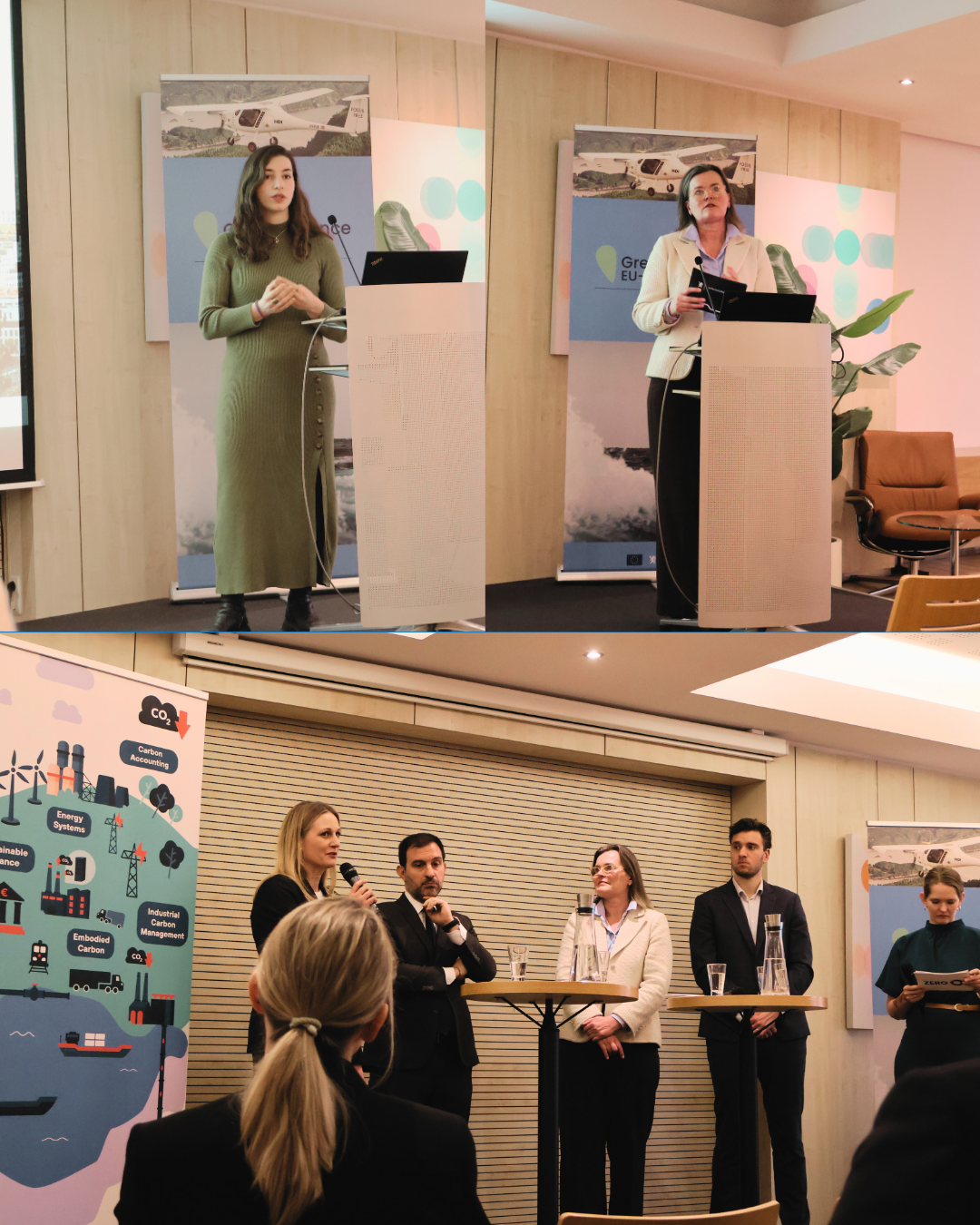
On 24 February 2025, Bellona Europa co-hosted a breakfast seminar at Norway House in Brussels alongside ZERO and the Mission of Norway to the EU, bringing together policymakers, manufacturers, and procurement practitioners around a single conviction: European cities hold a decisive and largely untapped lever for decarbonising construction. With the revision of the EU Public Procurement Directives on the horizon, the moment to use it is now.

Opening remarks and future of EU CRCF Market Christian Holzleitner, Head of Unit for Land Economy and Carbon Removals&nb...

Together with six NGOs and five industry partners, Bellona Europa signed a joint letter on the RFNBO Delegated Act, reiterating that now is not the t...
Get our latest news