
Joint letter – ICC reform and expansion risks diverting ETS Revenues from real climate action
In light of the European Commission’s ongoing considerations to amend the ETS State Aid Guidelines, revising the rules for Indirec...
News
Publish date: March 25, 2026
News
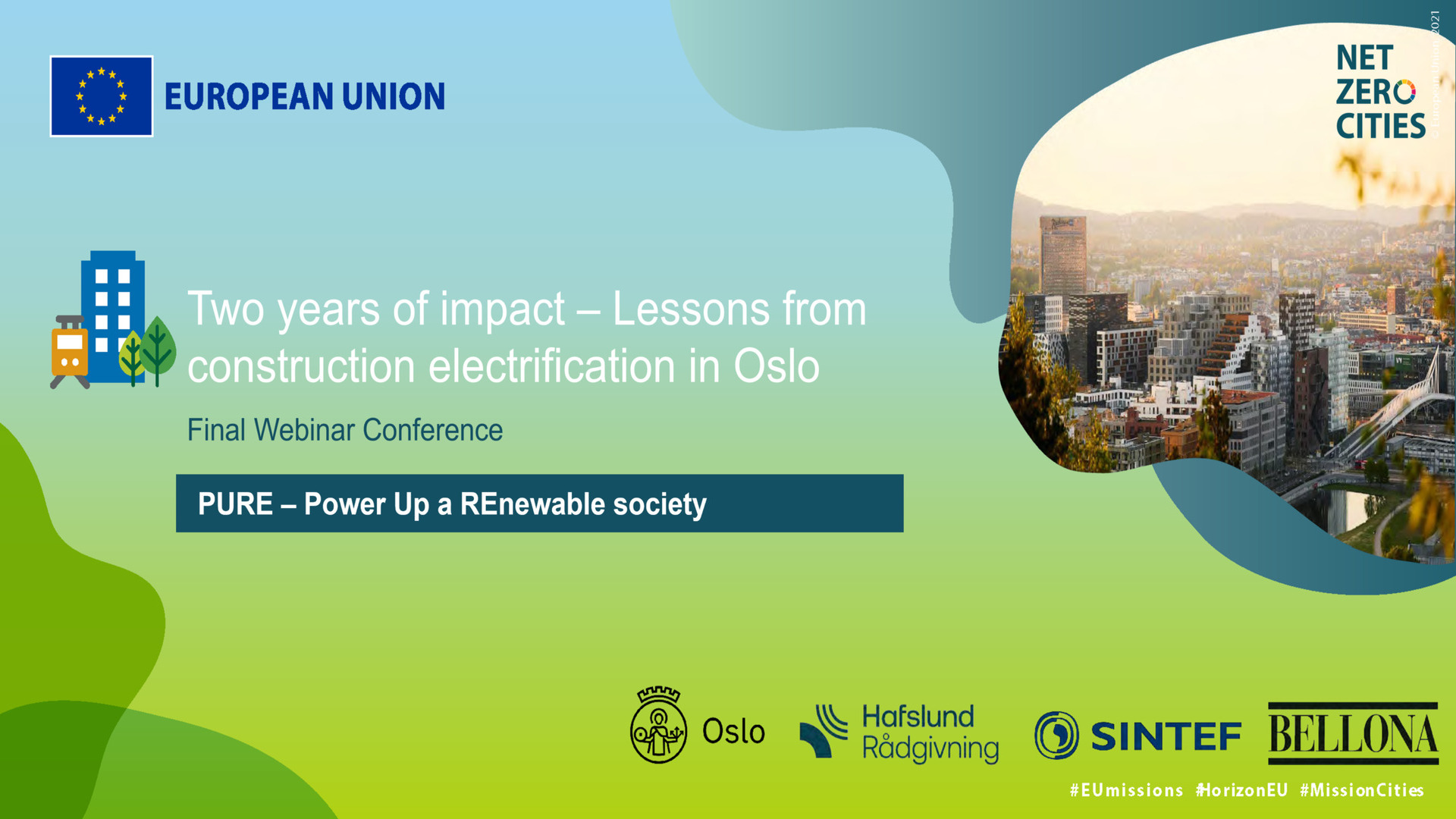
On 19 March, Bellona Europa, Oslo’s Climate Agency, Hafslund Rådgivning, and SINTEF hosted the concluding conference of the Powering-Up a REnewable Society (PURE) project. Throughout this two-year collaboration, partners examined how Oslo turned zero-emission construction sites from ambition into reality in less than ten years. Drawing on Oslo’s pioneering experience, the project produced research, guidelines, and advocacy materials that demonstrate the broader potential of electrifying construction operations and the pathway to zero-emission construction sites (ZECS) in Europe and beyond.
ZECS in Oslo: from experiment to requirement
In 2016, Oslo began exploring zero-emission construction machinery as a solution to reduce local climate emissions. At that time, electrifying construction operations was not being considered, except by Oslo itself.
Less than ten years later, 94% of Oslo’s civil works are zero-emission, with only 1% using fossil energy. This didn’t happen on its own but is rather the result of the smart use of green public procurement, market dialogues, and energy and technical planning.
Oslo has significantly contributed to the spread of ZECS in Europe and worldwide by actively participating in knowledge exchange platforms and city networks, and by collecting and sharing vital knowledge for public procurers and the private sector, including contractors and manufacturers.
The city is now ready to scale up its ambition. During the webinar, Oslo’s climate agency discussed the recently proposed Local Regulation on Emissions from Construction Sites. With this proposal, the city prepares to take the next natural step, expanding ZECS beyond municipal projects to include privately operated construction sites.
The city aims to require that by 2027, at least 30% of energy used in all construction sites comes from zero-emission solutions or biogas, with a goal to increase to 90% by 2030. This requirement will apply to larger construction and infrastructure projects, with exemptions allowed where implementation is technically impossible or excessively costly. The proposal aims to speed up technological development and establish predictable market conditions for zero-emission construction solutions.
Oslo has also launched its zero-emission construction site online hub, where the city is centralising all the knowledge on ZECS developed both within and outside the PURE project.
How can contractors successfully transition to zero-emission construction
– and how much does it cost?
ZECS are collaborative efforts that need the involvement of actors beyond city officials. That is why Hafslund Rådgivning has created two Guidelines for zero-emission construction sites, intended for contractors working on infrastructure, road, and building construction. These guidelines, available in Norwegian, English, and Chinese, demonstrate to contractors how to plan construction site operations and energy usage to maximise the benefits of zero-emission solutions and reduce the risk of bottlenecks on site.
Effective planning is crucial to reducing additional costs that may arise in the early stages of implementing zero-emission construction sites. However, once learning effects take hold, the cost increase for zero-emission construction sites at the project level can be as low as 1%, as Hafslund Rådgivning demonstrates in its cost analysis.
Importantly, while the upfront costs of zero-emission construction equipment remain a significant barrier, as discussed in the recent work of Hafslund Rådgivning and Bellona, the EU-level impact assessment on policy options for ZEMCON, initiating economies of scale and the expected decrease in costs for high-power battery manufacturing will increasingly strengthen the business case for electric-powered equipment in the future.
From Oslo, Barcelona, Eindhoven, to the EU – How European cities are leading the way in zero-emission construction
While Oslo is now the established north star for ZECS, more cities and infrastructure authorities across Europe are shifting towards zero-emission construction. Bellona Europa showed how the conditions that enabled Oslo to make ZECS the standard can be found in other regions that promote zero-emission construction equipment. Eindhoven and Barcelona, for example, adopted innovative strategies to address common obstacles such as long lead times for grid connection or a lack of on-site charging infrastructure. Like Oslo, both cities are leveraging green public procurement to foster this change, justified by the air pollution crisis and climate goals, with Barcelona also highlighting ZECS’s potential to reduce heat waste resulting from diesel-powered machinery.
While innovative cities across Europe show the viability of this new construction approach in different geographies, and for small and large-scale projects, more action by the European Union is necessary to strengthen the business case for zero-emission construction, as Bellona Europa emphasises in the policy brief launched during the event.
Specifically, Bellona urges the EU to eliminate indirect diesel subsidies for construction equipment and create a level playing field for zero-emission solutions. Importantly, mandatory green public procurement under the Public Procurement Directives and specific provisions under the Clean Vehicles Directive can act as catalysts for ZECS.
Additionally, effective guidelines on reducing construction pollution through air quality roadmaps and plans are crucial. In the policy brief, Bellona proposes prioritising zero-emission construction sites under the Energy Performance of Buildings Directive and introducing a zero-emission stage as an immediate next step in the Non-Road Mobile Machinery Regulation.
Paving the way to a greener future: Insights and innovations from zero-emission construction
What was clear from the SINTEF presentation is that the market readiness of zero-emission equipment has increased significantly over the past year. In 2025, 8% of construction equipment sales were electric, despite a decline in sales of diesel-powered equipment. Original Equipment Manufacturers (OEMs) are now supplying about 500 types of machinery, with excavators and wheel loaders leading in supply. Importantly, in 2025, the availability of heavy machinery has grown considerably, indicating increased manufacturing capacity for heavy-duty batteries.
In Oslo, over the past four years, around 66 construction sites were fully electric, saving about 15,800 tCO2e from construction machinery. But the benefits extend beyond climate, including improved air quality, reduced noise pollution, and better working conditions and communication on site.
Conclusion
The PURE project examined what the experience of Oslo revealed about greenhouse gas mitigation, public health, workers, and climate innovation. Since then, contractors have learned how to maximise efficiency gains that zero-emission solutions offer, and workers in an increasing number of cities across Europe are experiencing better working environments.
Municipalities are discovering that effective energy and technical planning can significantly reduce additional costs today, and it’s evident that in the long run, the net impact will be overwhelmingly positive. These realisations are reflected in the electric construction equipment markets, where the supply of equipment, regardless of size and category, is increasing, along with sales shares.
However, it is now important to strengthen demand for zero-emission construction equipment and make it predictable, enabling European manufacturers to gradually introduce these solutions in European markets.
Zero-emission construction sites can play a vital role in addressing complex and multidimensional challenges like climate change and pollution. The benefits of this transition are not to be delayed to a distant future; they are already being experienced today by workers and city residents, who enjoy reduced air pollution and noise.
The Oslo and the PURE project partners have demonstrated what is achievable and the pathway to reach it. Next, the European Union should take ownership and draft the necessary legislative changes to drive change for a better, fairer construction sector that benefits all.
In light of the European Commission’s ongoing considerations to amend the ETS State Aid Guidelines, revising the rules for Indirec...

On March 10th 2026, the Commission presented the Clean Energy Investment Strategy, as part of an Energy package to boost investment in homegrown cle...

By Amélie Laurent, CDR Policy Advisor, Bellona Europa Published in REVOLVE Today, EU countries approved Europe’s 2040 climate target:...
The new EU Ports Strategy rightly recognises that ports are no longer just logistics hubs – they are be...

Three main asks: Set robust low-carbon definitions as soon as possible: Without clear thresholds, non-price criteria in procurement lack the dec...
Get our latest news