
Joint letter – ICC reform and expansion risks diverting ETS Revenues from real climate action
In light of the European Commission’s ongoing considerations to amend the ETS State Aid Guidelines, revising the rules for Indirec...
News

Publish date: April 14, 2015
News
The significant contribution of the iron and steel sectors towards CO2 emissions is due to the energy intensity of steel production, its reliance on carbon-based raw materials and fuels, and the large volumes of steel produced. Total UK steel sector emissions amounted to 16.6 million tonnes of CO2 in 2011, and inflating to 22.8 million tonnes in 2013. The sector accounts for 9% of industry’s energy use, the majority of which is used for high-temperature processes.
Despite industry’s long-term commitment to reduce its CO2 emissions, the UK iron and steel sector continued to consume large amounts of energy, over 70% of which is used to provide heat, often at very high temperatures (over 1,000°C). The steady increase of emissions in recent years also reflects the limits to technological opportunities that can further improve energy efficiency, with only relatively small incremental improvements in energy consumption.
The study concludes that CCS technology will need to play a key role in the deep decarbonisation of the iron and steel sector. Its significant contribution is made clear in the graph below, based on the following assumptions (DECC, March 2015):
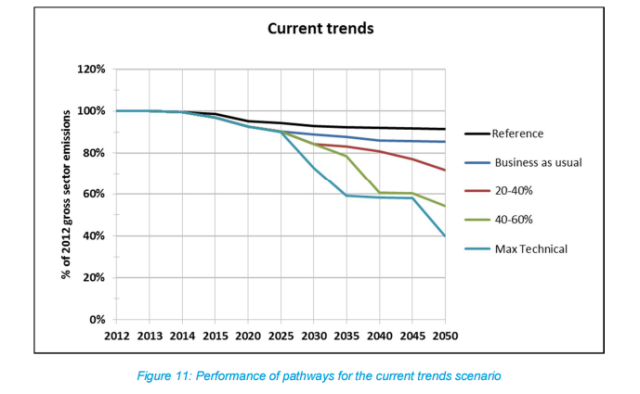
The study also notes that the ‘Max Tech’ emission reduction pathway is based on the assumption of availability of CCS technologies. In the absence of CCS, only emission reductions of 41% can be achieved, as opposed to 60% or more with CCS. What is more, the combination of CCS with sustainable biomass would achieve a 63% emissions reduction.
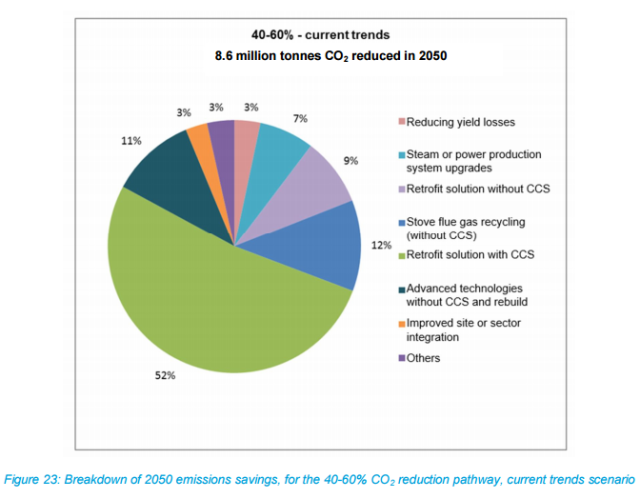
The graph below illustrates a breakdown of the 2050 emissions savings for the 40-60% CO2 reduction pathway. In this scenario, the key role of CCS is made clear, as 52% of emissions reduced in 2050 would stem from the application of CCS.
The DECC studies make the case for CCS in energy intensive industries increasingly clear. In a society and economy with an urgent need to reduce emissions, the pathway to retaining and growing the industrial and employment base is through CCS. For more on the case of decarbonising the cement sector, read this article.
In light of the European Commission’s ongoing considerations to amend the ETS State Aid Guidelines, revising the rules for Indirec...

Co-authored by: Amélie Laurent, Bellona Europa and Kenneth Möllersten, IVL Swedish Environmental Re...

By Enrico Cipelli Alves, Policy Advisor, Sustainable Markets & CCS Published in Revolve This year’s Strait of Hormuz disruption&...
On 17 July, the European Commission unveiled the long-awaited Electrification Action Plan (EAP), alongside with a regulation...

Today, the European Commission published its long-awaited proposal for the review of the EU Emissions Trading System (ETS), ...
Get our latest news