Competitiveness without climate: Why Europe’s industrial week missed the mark
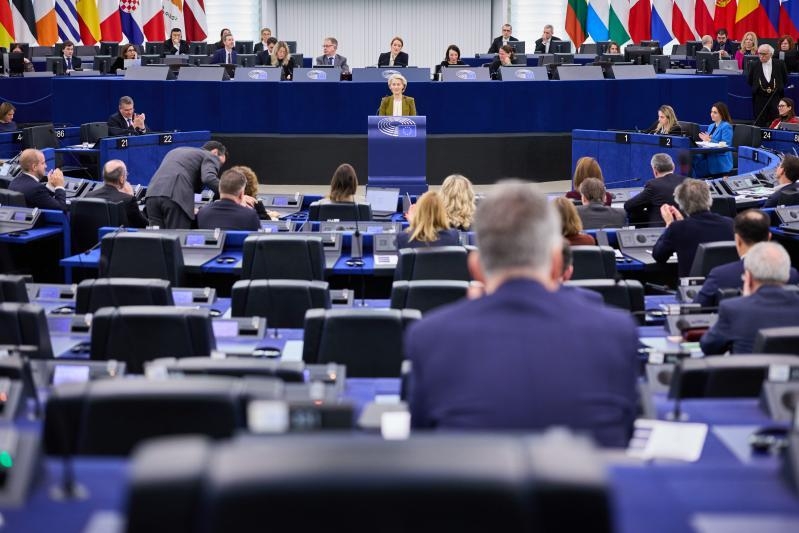
In this week of industrial discussions, first at the Antwerp Industry Summit on February 12th and then at the informal EU leaders’ meeting at Alden Biesen, crucial conversations have taken place about European competitiveness.
The aftermath leaves civil society with deep concerns: while some welcome defences of climate policy were heard at the Industry Summit, decarbonisation and climate action was remarkably absent from the EU leader’s conclusions.
It is important to note that the Industry Summit took place amidst a troubling lack of transparency and participation, with civil society deliberately excluded from the discussions. While CEOs and industry representatives had direct access to Commission President von der Leyen and the leaders of Austria, Belgium, the Netherlands, France, and Germany, those who will bear the consequences of industrial policy choices, such as environmental groups, labour unions, citizen representatives and wider society as a whole, were shut out.
The EU must stay the course on decarbonisation, including ETS
We commend Commission President von der Leyen and Climate Commissioner Hoekstra for holding firm in defence of Europe’s bedrock climate policy, the EU Emission Trading System.
However, we must sound a note of caution. The same day, German Chancellor Friedrich Merz told the Antwerp audience that ‘if [the ETS] is not the right instrument, we should be very open to revising it, or at least to postpone it’—to loud applause from industry. French President Emmanuel Macron similarly warned against ‘high energy prices, combined with carbon costs, accelerating deindustrialization.’
We warn Member State leaders in the strongest terms: weakening the ETS would be an act of economic and environmental self-sabotage. The policy is delivering exactly what it was designed to do: drive emissions reductions while enabling economic growth. Undermining it now, just as global carbon pricing is expanding and clean product markets are crystallising, would strand European industry in high-carbon pathways and guarantee competitive decline. It is crucial to bear in mind that our dependency on fossils and swings in that market resulting from geopolitical developments have contributing in great deal to increases in energy costs. Not recognising the urgent need to reduce our dependency on fossil energy will only keep Europe in a vulnerable position to shocks and volatility, whereas renewables and decarbonisation offer the stable alternative in the long-run.
«Stability does not mean freezing policy, nor gutting it. The predictable phase-out of free allowances is precisely what gives investors’ confidence, drives innovation, and aligns the ETS with Europe’s long-term climate and competitiveness goals. »
Francesco Lombardi Stocchetti
Policy Manager, Carbon Leakage and International Competitiveness
Business needs predictability, but this predictability should be set around Europe’s trajectory toward net-zero, not as a deviation from that trajectory. The simplification agenda must not become a vehicle for weakening environmental standards under the guise of reducing administrative burden. Simplification should be understood as a tool to facilitate implementation and speed up the transition towards a clean economy.
Following Antwerp, EU leaders gathered at Alden Biesen for an informal competitiveness retreat. President von der Leyen announced an ambitious ‘One Europe, One Market’ roadmap to be presented at the European Council in March.
What is deeply troubling is what was absent: any meaningful discussion of climate, decarbonisation, or low-carbon products-the very backbone of the Industrial Accelerator Act and Europe’s long-term competitiveness.
Claims that climate action comes at the expense of competitiveness ignore the fundamental reality that there is no economic competitiveness in a climate-destabilised world. Competitiveness without climate action is a mirage. Such views are short-sightedly focusing on get-growth-quick schemes and short-term competitiveness gains and want to weaken climate action as a means to that end.
In reality, the only way to secure short and long-term industrial competitiveness, with societal support, is to accelerate the transition to renewable and clean technologies while at the same time addressing the social impacts of the transition through just transition measures such as support for affected workers and regions, reskilling, strengthening social protection, and social conditionalities for public climate funding. Socially just climate action is the only sensible and future-proof way forward.
Lead markets measures, including through the IAA, must drive low-carbon demand
Von der Leyen announced that the Industrial Accelerator Act (IAA), ‘including a European preference,’ would be presented before the next European Council ‘for strategic sectors based on solid economic analysis.’ This is welcome news—but only if the IAA delivers on its original promise as an Industrial Decarbonisation Accelerator Act.
Strengthening Europe’s production base is essential, but we must be clear about what we are strengthening. Europe’s competitive advantage lies not in high-carbon manufacturing locked into yesterday’s technologies, but in clean industrial production. Investment in European manufacturing capacity must be conditional on lifecycle emissions performance, and it should be an investment in the decarbonisation of our industry.
The IAA could provide the vehicle, but only if it establishes mandatory green public procurement with clear low-carbon thresholds and demand-side obligations that create genuine market pull for clean products. Not only that, but it should also set the ground for private demand to follow. Yet the leaders’ retreat produced no takeaways on low-carbon criteria, lifecycle emissions thresholds, or the climate conditionalities that must underpin any European preference mechanism. This is extremely shortsighted.
A European preference without climate criteria risks subsidising carbon-intensive production simply because it happens within EU borders. Any preference mechanism must be conditional on demonstrably lower lifecycle emissions. Otherwise, we risk creating a protectionist framework that locks in high-carbon pathways and leaves Europe unable to compete as global markets shift toward clean products.
«The objective of the Clean Industrial Deal must remain at the centre of the discussions, which is, first and foremost, to support demand creation of low-carbon products. If there is to be a European preference criterion, this should be tied together with low-carbon criteria, to safeguard our long-term competitiveness. »
Irene Domínguez Pérez
Policy Manager, Embodied Carbon & Lead Markets
Local content requirements may be justified in specific strategic contexts, if they deliver genuine climate and resilience benefits. However, a local content requirement should only apply if the European product has demonstrably lower lifecycle emissions than alternatives. The upcoming revision of the Public Procurement Directives must harmonise sustainability criteria across Member States and make green public procurement mandatory above certain thresholds.
Energy systems: the grid is Europe’s competitiveness infrastructure
Von der Leyen rightly recognised that grid infrastructure is critical, with the Grids Package to receive a timeline in the March roadmap and implementation of European Energy Highways. Von der Leyen also correctly identified the great opportunity in the cost differential between renewables at €34/MWh, and gas at €100/MWh.
«The grid is Europe’s competitiveness infrastructure: a no-regrets investment that turns renewable potential into reliable, competitive electricity prices by cutting curtailment, unlocking flexibility and lowering system costs over time. The Grids Package must deliver faster build-out and smarter planning to make that happen»
Ganni Vassallo
Policy Manager, Energy Systems
Von der Leyen indicated that the merit order system (which currently sets electricity prices based on the most expensive source needed) is under review. She promised to bring ‘different options and findings’ on market design to the March Council. Any reform must ensure to make the best use possible of renewable sources and avoid introducing fossil fuel subsidies disguised as grid stability measures. Crucially, reforms must also preserve the carbon price signal embedded in electricity markets: exposure to carbon costs on emitting generation is a key driver for renewable uptake and long-term clean power procurement. Shielding industry from this signal would weaken investment incentives and slow down decarbonisation.
The €500 billion in grid investments needed by 2030 are not optional, they are the foundation of industrial competitiveness in a decarbonised economy. Every euro invested reduces future system costs, lowers consumer bills, and unlocks Europe’s massive renewable potential. Market design reforms must complement, not undermine, this transition.
Conclusion: forgetting climate means shooting ourselves in the foot
Europe faces a clear choice: lead the global industrial decarbonisation race and reap the economic rewards, or cling to outdated production methods and watch as our industrial base becomes uncompetitive. Carbon border adjustments are proliferating worldwide. Clean product markets are growing rapidly. Countries that subsidise high-carbon production today will find themselves with stranded assets tomorrow.
Forgetting climate action in the pursuit of competitiveness is not strategic—it is shooting ourselves in the foot. The two goals are inseparable, as the ETS data proves. Competitiveness requires decarbonisation, not despite it.
Our call to the formal March European Council:
Make decarbonisation central to the One Market roadmap. Low-carbon criteria must be embedded in the Industrial Accelerator Act and all competitiveness measures.
Protect and strengthen the ETS. Maintain the predictable phaseout of free allowances and require Member States to reinvest a significant share of ETS revenues to support decarbonisation projects in industries covered by the ETS.
Accelerate grid infrastructure investment. The Grids Package must be finalised with ambitious timelines and forward-looking planning that prioritises renewables and interconnectors.
Put people at the centre. Competitiveness must also mean preparing Europe’s workforce to meet the skills demands of a decarbonised economy. Our European workforce keeps the economy running; they must be supported through the transition with reskilling, quality jobs, affordable clean energy, liveable communities, and a stable climate, not just a focus on corporate gains. This is also key for securing crucial public support for a rapid transition.
The upcoming meeting of the European Council will determine whether Europe’s competitiveness agenda becomes a vehicle for climate leadership or climate regression. The stakes could not be higher. Leaders must choose the path that secures both prosperity and sustainability; because in the 21st century, there is no competitiveness without decarbonisation.