Article 23 on Trial: How Oil and Gas Producers Are Challenging the EU’s CO₂ Storage Obligations
Fifteen legal cases brought by oil and gas producers are challenging a key provision of the EU’s Net-Zero Industry Act, putting Europe’s 2030 CO₂ sto...
Publication

Publication
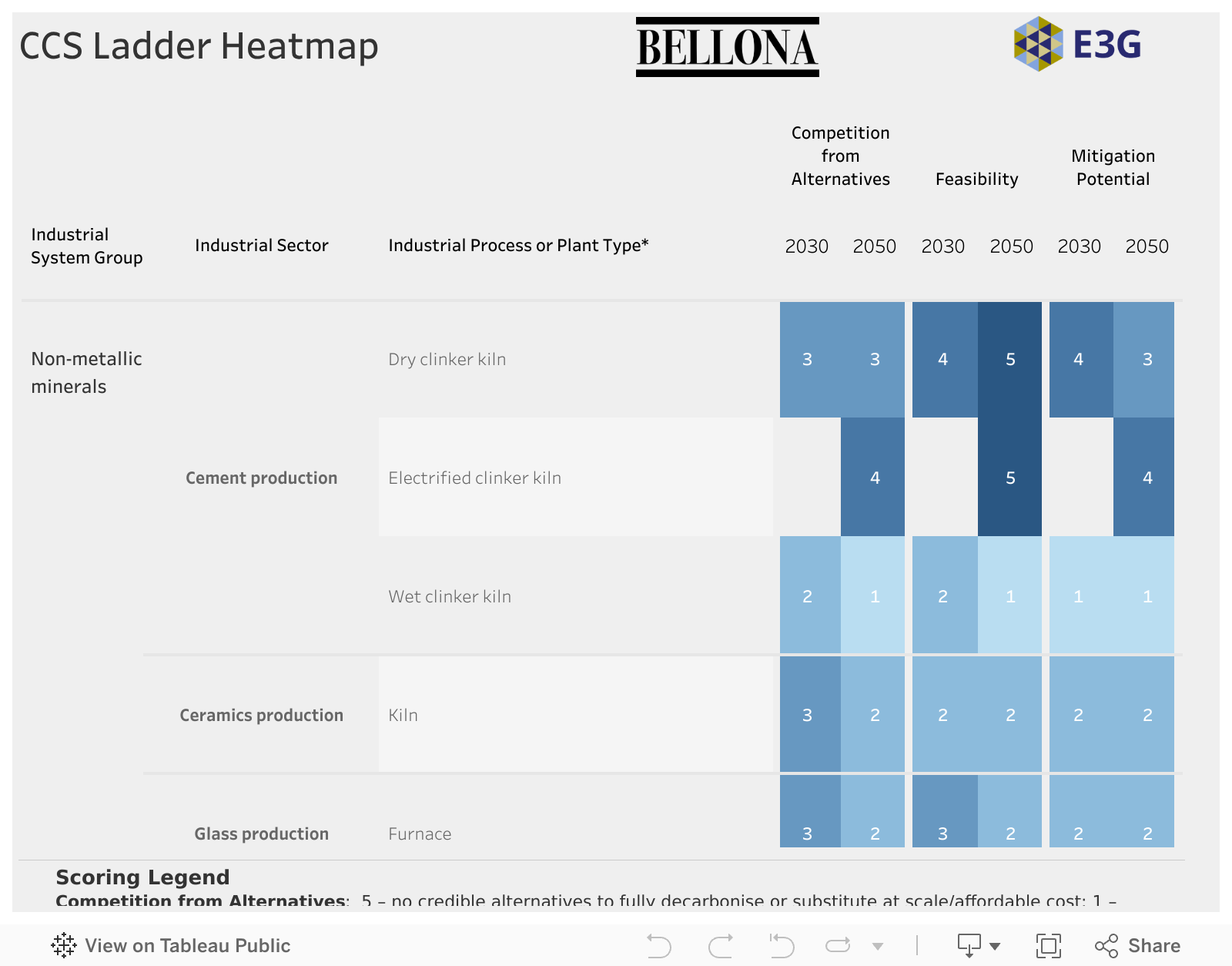
When E3G and Bellona Deutschland first published the CCS Ladder in 2023, the goal was to bring more differentiation to the polarised debate around CCS. Carbon capture and storage (CCS) has often been treated as a monolithic “yes-or-no” technology. What was missing was a structured classification: Where do CCS applications actually deliver lasting climate benefits – and where does the use of the technology threaten to delay more profound transformation?
With CCS Ladder 2.0, we are now presenting a comprehensively updated version of this assessment framework.
The climate benefits of CCS are dynamic and are expected to decrease in many areas if alternatives such as electrification, renewable electricity, circular economy and demand reduction successfully scale. In numerous applications – for example in the power sector or in processes with low to medium-high heat demand – alternatives CCS are already superior. At the same time, CCS is expected to remain indispensable for almost complete decarbonisation in certain areas – such as process-related emissions in lime and cement clinker production or in the thermal treatment of relevant proportions of various waste categories – at least in the medium term. Waiting for possible alternatives is too great a risk here in view of the climate policy necessity of a rapid and effective reduction of emissions.
At the same time: where CCS is most urgently needed, it is not always the easiest or cheapest to implement. A pure focus on short-term avoidance costs would therefore often favor those projects where CCS is easily feasible – not necessarily those that are strategically crucial for a profound industrial transformation. Considerations on prioritisation must therefore take a joint look at climate benefits, system relevance and long-term transformation paths.
Get our latest news