
Joint letter – ICC reform and expansion risks diverting ETS Revenues from real climate action
In light of the European Commission’s ongoing considerations to amend the ETS State Aid Guidelines, revising the rules for Indirec...
News
Publish date: February 26, 2026
News
Construction machinery is one of the most significant, and least regulated, sources of emissions and urban air pollution in Europe. Non-road mobile machinery accounts for nearly 3% of EU greenhouse gas emissions, while twelve European countries emitted a combined 56,860 tonnes of NOx and 2,380 tonnes of PM2.5 from construction NRMM in 2023 alone. A single excavator can pollute as much as 20 cars. Yet this sector remains the last major category not covered by EU climate legislation.
The technology to change this exists. Battery-electric construction machinery is now market-ready for the majority of equipment categories. According to an upcoming EU-level impact assessment co-authored by Bellona and Hafslund Rådgivning, cost premiums are moderate, declining rapidly, and expected to narrow further as markets scale. The barrier is not technical, it is demand.
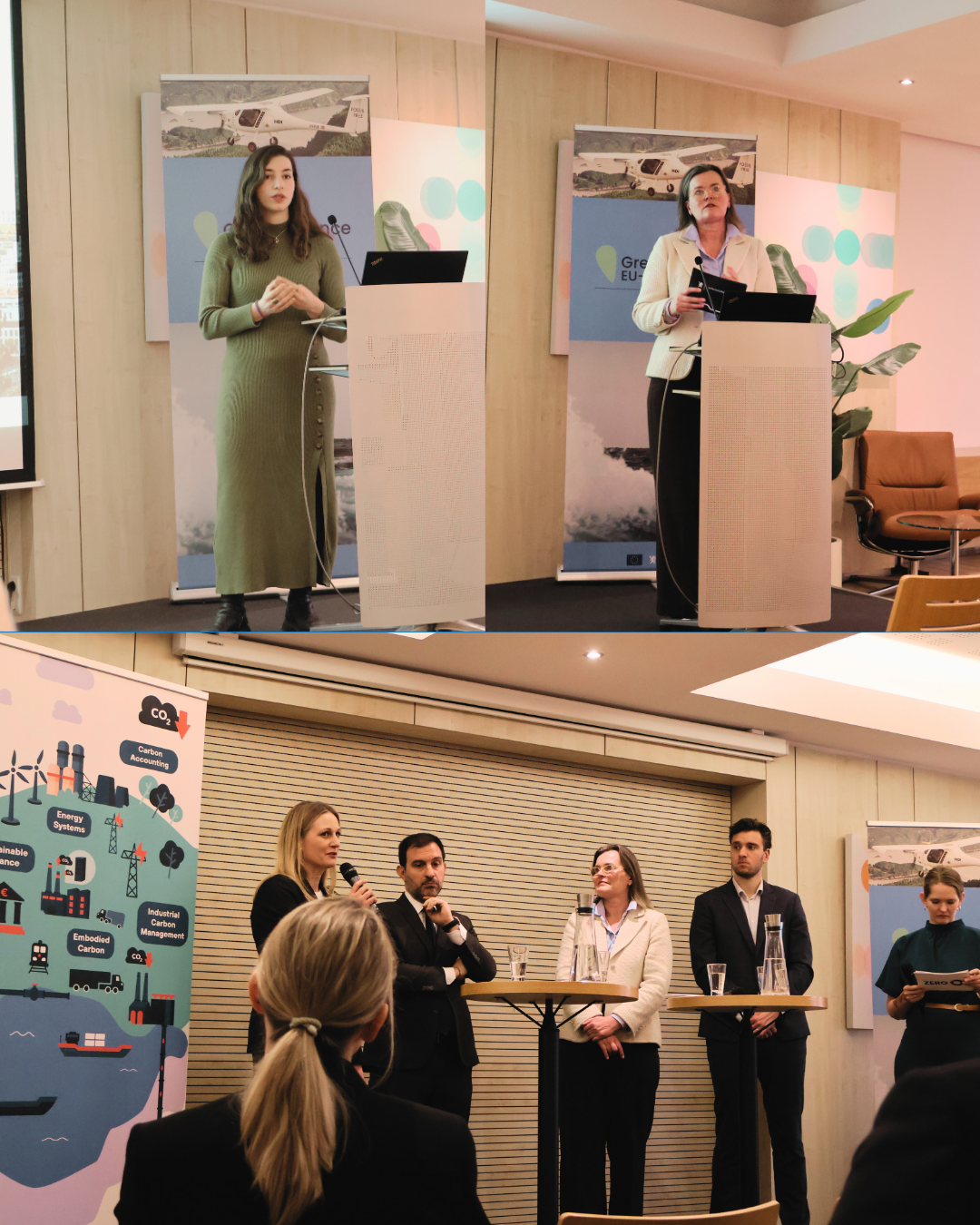
Norway’s State Secretary for Transport Abel Cecilie Knibe Kroglund opened the seminar with a clear message: the technology is ready, and the EU must now act on the regulatory gap. Since 2015, Oslo has implemented a step-by-step strategy, progressing from fossil-free to fully zero-emission requirements, that has turned public procurement into a market-creation tool. From 2025, all public construction projects in Oslo must be zero-emission, with a citywide target, including private developments, of 100% by 2030.
«Battery-powered machines can do the job. I believe we need further regulations to reduce greenhouse gas emissions from this sector in the EU.»
Abel Cecilie Knibe Kroglund
Norway’s State Secretary for Transport
The lesson from Oslo is that procurement-led demand broke the chicken-and-egg problem: consistent public requirements gave manufacturers the signal to invest in scaling production, which in turn drove down costs. Oslo’s decade of experience shows that targeted procurement policy is precisely the remedy.
Europe’s public purchasing power remains largely misaligned with its climate ambitions. According to European Commission data, 55% of EU tenders still award contracts on the basis of lowest price alone, bypassing the environmental criteria that the existing directive (2014/24/EU) already allows through the Most Economically Advantageous Tender (MEAT) principle.
The forthcoming revision of the Public Procurement Directives is a unique opportunity to fix this. A revised directive that makes environmental criteria and life-cycle costing mandatory in public construction contracts would generate the sustained, harmonised demand signal that individual pioneering cities cannot produce alone. It would also serve European industrial interests: the global electric construction equipment market is projected to grow from USD 10.5 billion in 2023 to USD 70.1 billion by 2032, and European OEMs need the home market demand to compete with rapidly scaling Chinese rivals. Otherwise, we risk repeating the same mistake as with electric vehicles, with indecision making European industry lag behind.
The PPD revision does not stand alone. The expected expansion of the Clean Vehicles Directive to cover non-road mobile machinery, the Electrification Action Plan, and the European Grids Package all represent complementary opportunities to bring EU policy into alignment with what leading cities are already doing.
For the directive revision to change practice rather than just law, cities need operational support: tools to identify available zero-emission machines, draft enforceable specifications, and share what works. The Community of Practice on Zero Emission Construction Sites (CoP ZECS), under the Big Buyers Working Together project, is building exactly that infrastructure.
In May 2025, CoP ZECS and Bellona Europa launched the updated Emission-Free Construction Equipment Database, listing 170+ products across 22 categories with full technical specifications. It is publicly accessible at https://www.bellona.org/database-emission-free-construction-equipment-by-manufacturer and downloadable in Excel. Alongside peer learning and shared procurement templates, it gives contracting authorities across Europe the evidence base to write effective zero-emission requirements today, without waiting for revisions or new legislation.
The technology is ready. The legal basis exists. Cities are leading the way. Now the European Union must do everything in its power to ensure that the transition happens across the continent, retaining our competitive industry while reducing emissions.
The ZEMCON Impact Assessment was prepared by Hafslund Rådgivning and Bellona for NetZeroCities and the City of Oslo (February 2026). For more on the Big Buyers Working Together project and CoP ZECS: big.buyers@eurocities.eu
In light of the European Commission’s ongoing considerations to amend the ETS State Aid Guidelines, revising the rules for Indirec...
Ahead of the European Commission’s post-2030 energy framework proposal expected by the end of the year, we, joined by more than 90 industry ass...

Wednesday, September 16, 2026 – Brussels, Belgium Recognising the existence of climate change impacts i...

Wednesday, September 9, 2026 – Brussels, Belgium Today, the European Commission proposed a new Public Procure...

Co-authored by: Amélie Laurent, Bellona Europa and Kenneth Möllersten, IVL Swedish Environmental Re...
Get our latest news