
Joint letter – ICC reform and expansion risks diverting ETS Revenues from real climate action
In light of the European Commission’s ongoing considerations to amend the ETS State Aid Guidelines, revising the rules for Indirec...
News
Publish date: April 8, 2005
News
Analysis
The study has global impact following the recent the ratification of the Kyoto protocol because signatory countries could unwittingly be adding to the very greenhouse gas emissions they are trying to reduce by importing goods that contain carbon dioxide producing elements manufactured in countries that are not bound by the treaty.
Dr. Glen Peters and colleagues at the Industrial Ecology Programme of the Norwegian University of Science and Technology (www.www.indecol.ntnu.no)
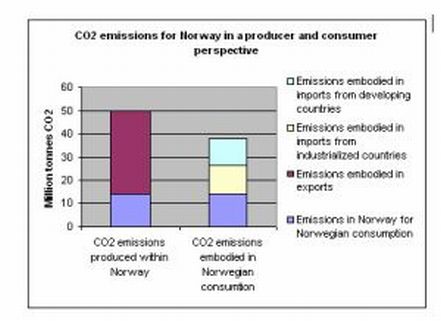
have in a recent study shown that carbon dioxide emissions embodied in imports represent a large fraction of the emissions associated with consumption in Norway.
Current climate change policies dont take this into account as they are based on emissions within geographical boundaries—or production in a given country. Dr. Peters suggests that future climate change policies should either make the consumer responsible for emissions or alternatively, include emissions targets for all countries.
The full scientific paper can be downloaded in pdf format at www.indecol.ntnu.no/indecolwebnew/publications/papers/workingpaper04/workingpaper6_04web.pdf
Imports most important contributor to carbon dioxide-emissions
In their paper Pollution Embodied in Norwegian Consumption, Peters and his colleagues apply a technique called multi-regional input-output analysis together with international trade statistics and emissions data for Norways most important trading partners. Through this technique, Peters is able to calculate in his study the carbon dioxide emissions associated with consumption of goods in Norway, as well as tracing which countries emit the pollution.
Although only 16 percent of the household consumption in Norway is accounted for by imported goods, approximately 63 percent of the total carbon dioxide emissions are embodied in imports. One of the most important reasons for this is the unique energy supply in Norway, which consists almost entirely of hydropower that facilitates clean production of products in comparison to most other countries. It therefore follows that imports contribute more to carbon dioxide-emissions relative to Norwegian production.
A significant part of the emissions occur in developing countries not obliged to reducing greenhouse gas emissions—the so-called non-Annex I countries in the Kyoto Protocol. Industries in developing countries generally perform far worse than industrialized countries in environmental terms.
If Norwegian consumers were responsible for the carbon dioxide-emissions, then market mechanisms may provide incentives to shift production to countries with cleaner technologies, or to develop cleaner technologies in developing countries. This point is particularly evident in the clothing sector, where 97 percent of Norwegian consumption is imported. Of this about 52 percent comes from developing countries and represents 94 percent of the emissions associated with the consumption of clothing.
Christian Solli, a research assistant at Norwegian University of Science and Technologys Programme for Industrial Ecology, contributed to this report.
In light of the European Commission’s ongoing considerations to amend the ETS State Aid Guidelines, revising the rules for Indirec...

Wednesday, September 16, 2026 – Brussels, Belgium Recognising the existence of climate change impacts i...

Wednesday, September 9, 2026 – Brussels, Belgium Today, the European Commission proposed a new Public Procure...

Co-authored by: Amélie Laurent, Bellona Europa and Kenneth Möllersten, IVL Swedish Environmental Re...

By Enrico Cipelli Alves, Policy Advisor, Sustainable Markets & CCS Published in Revolve This year’s Strait of Hormuz disruption&...
Get our latest news