
Joint letter – ICC reform and expansion risks diverting ETS Revenues from real climate action
In light of the European Commission’s ongoing considerations to amend the ETS State Aid Guidelines, revising the rules for Indirec...
News

Publish date: August 20, 2026
News
Co-authored by: Amélie Laurent, Bellona Europa and Kenneth Möllersten, IVL Swedish Environmental Research Institute and KTH Royal Institute of Technology
As the European Commission published its review of the EU Emissions Trading System (ETS), one of the first steps towards implementing the 2040 climate target to reduce emissions by 90%, Europe is moving towards the most challenging sources of emissions, “residual emissions”.
But one key piece is missing: a clear approach to residual emissions, which remain undefined in the policy architecture. It is time to address the elephant in the room. Europe cannot claim it will become the world’s first climate-neutral continent by 2050 without defining what residual emissions are and how to deal with them.
The EU therefore needs a Residual Emissions Strategy that defines residual emissions, identifies their sources, explains how they must be continuously reduced, and clarifies how they should ultimately be counterbalanced. The starting point must be clear: residual emissions must be minimised, not assumed.
That also means being realistic about the limits of land sinks and permanent carbon removals for counterbalancing residual emissions. Expectations must be grounded in what can realistically be delivered sustainably and at scale.
Waiting is also a risk. If we treat some emissions as “unavoidable” too early, without properly examining whether they truly are, we risk following a more costly and less efficient path to climate neutrality.
Defining residual emissions
The EU residual emissions strategy should define residual emissions. Even in a net zero – and later net negative – world, some greenhouse gas emissions will remain. But “residual emissions” are not “hard-to-abate” emissions. Hard-to-abate applies today. Residual emissions look towards net zero.
That difference matters. Some emissions may be technically very hard or expensive to reduce, but still not truly unavoidable. Residual emissions are what is left after all feasible reductions have been pursued, based on technical, economic or social constraints.
This definition must evolve over time. It should be ambitious, but also updated over time. As technology, policy and societal expectations evolve, what is considered unavoidable today may no longer be tomorrow.
This raises difficult but necessary questions. What count as reasonable or unreasonable costs, especially when weighed against the consequences of inaction or delay? To what extent should economic considerations play a role? These questions cannot be postponed.
Because, if the EU does not act, the market will define the outcome instead.
Identifying and addressing residual emissions
This strategy must map and quantify residual emissions across all sectors and all greenhouse gases. This cannot be a one-off exercise, but a continuous process updated as technologies and policies evolve.
It must cover the whole economy, without exemptions or blind spots. No sector should assume it is outside the scope or automatically “residual by default.” A bottom-up sectoral assessment should inform its design, including Member State and greenhouse gas breakdowns.
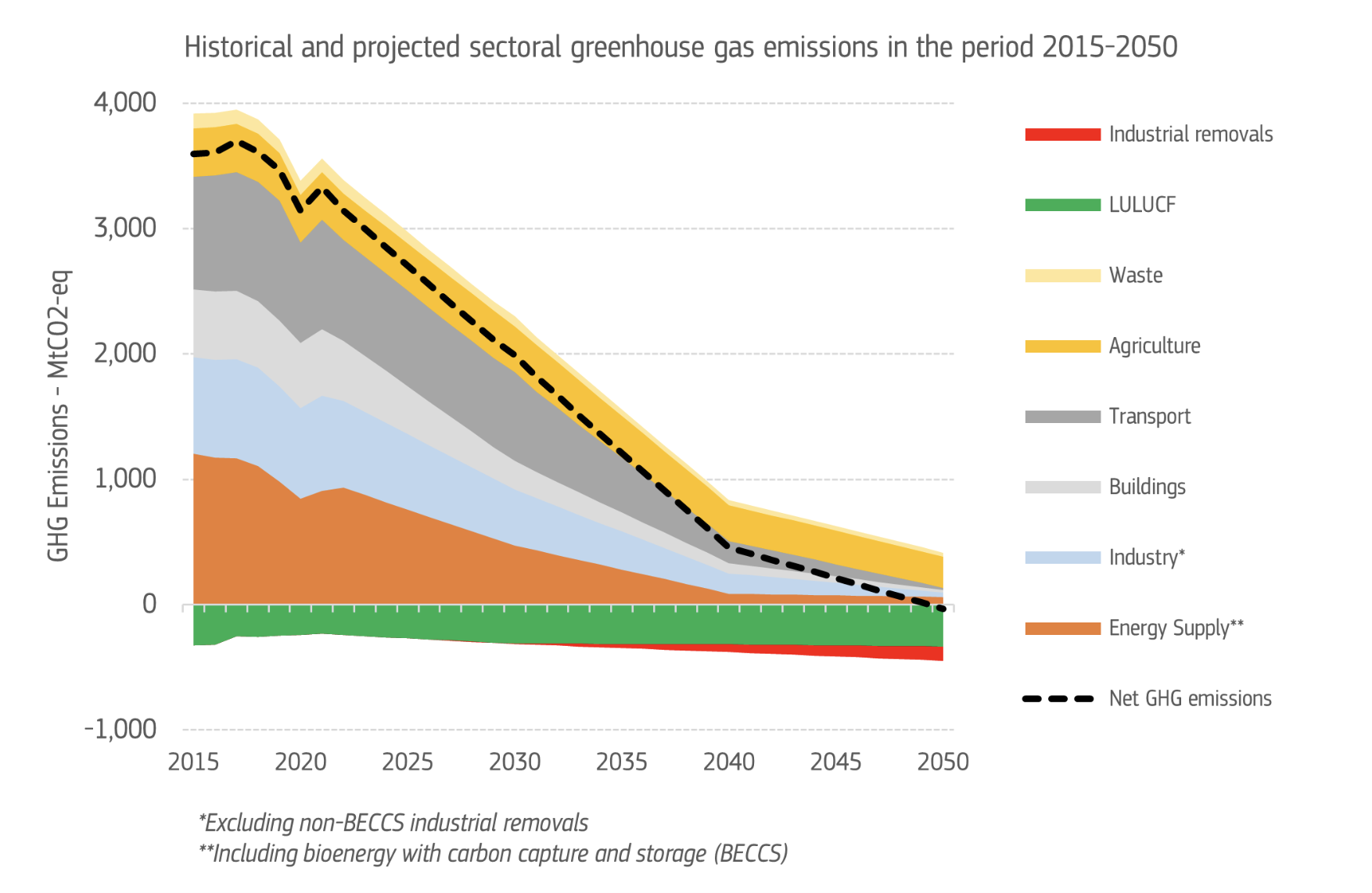
Residual gross emissions in the EU are currently estimated at around 411 MtCO₂e, with a large share coming from agriculture, industry and aviation.
Identification is only the first step. The strategy must also explain how to address these emissions through an action plan, with concrete measures, binding where necessary. That means a mix of structural policy measures, demand reduction, and behavioural change.
Counterbalancing residual emissions
The strategy should explain how residual emissions will be balanced over time, by matching remaining emissions with a portion of land sinks and permanent carbon removals.
To do this, the EU must scale up both natural carbon sinks and permanent removals as two separate pillars, while applying the like-for-for like principle, ensuring that different types of emissions are counterbalanced with removals of a comparable level of storage permanence.
It requires binding land sinks targets to reverse the decline of these sinks, then protect and enhance them over time. These sinks also support climate adaptation and biodiversity. But they are not a silver bullet, and cannot compensate for ongoing emissions or simply “absorb our mess.”
Alongside this, the EU needs a separate framework for permanent removals with strict sustainability rules. Without a clear strategy, there is a risk that removals end up slowing emission reductions rather than complementing them.
The direction of travel must remain clear: residual emissions should continuously decline, and the need for counterbalancing should never become a substitute for emissions reductions.
Why Europe cannot wait
Europe needs a strategy to define, address, and ultimately counterbalance residual emissions. Without it, anything can be labelled “residual” once ambition runs out.
The ETS review makes this debate urgent: Europe must determine how climate policy evolves as emissions approach net zero.
A residual emissions strategy is the missing link between current policy and a net zero – and net negative – future.
It is also a test of leadership. Europe has the chance to be the first major economy to set up a clear framework for residual emissions, and in doing so, define what credible climate neutrality means in practice.
In light of the European Commission’s ongoing considerations to amend the ETS State Aid Guidelines, revising the rules for Indirec...
This year, the European Commission has committed €3.4 billion in grants from the Innovation Fund. Financed through revenues from the EU’s Emission Tr...
By Linda Zarai, Policy Advisor, Clean Construction On September 23, Oslo City Council adopted a local resolution that extends the zero-emission co...

Wednesday, October 21, 2026 – Brussels, Belgium The European Union has published its new Arctic Strategy, and it is good news for the climate. One...

By Carl Emil Meier, Policy Advisor, Nordics Denmark is widely recognised as a pioneer in wind energy, which remains one of Europe’s key drivers of...
Get our latest news