
Joint letter – ICC reform and expansion risks diverting ETS Revenues from real climate action
In light of the European Commission’s ongoing considerations to amend the ETS State Aid Guidelines, revising the rules for Indirec...
News

Publish date: October 19, 2026
News
By Carl Emil Meier, Policy Advisor, Nordics
Denmark is widely recognised as a pioneer in wind energy, which remains one of Europe’s key drivers of the clean energy transition. In recent years, Denmark has also recognised Carbon Capture and Storage (CCS) as an important tool for achieving its net-zero and net-negative climate targets, particularly in hard-to-abate industrial sectors where direct electrification alone is not yet a complete solution.
This has led to a significant acceleration in the development of Denmark’s CCS market, as the country builds the infrastructure, policy framework and commercial partnerships needed to capture, transport and permanently store CO₂.
On Friday the 18th of September, the first full-scale operational CO2 storage site, Greensand, was inaugurated in the Danish port of Esbjerg, both the world’s largest base port for offshore wind activities, and in close proximity to many potential CO2 storage sites in the Danish North Sea.[1] The Greensand Future offshore storage site receives CO2 shipped out from the Danish port of Esbjerg, captured at point sources such as the Bigadan biogas plant in the Danish city of Kalundborg, or imported from the Swiss biomethane project CO2 Energie AG.[2],[3]
The event was hosted by INEOS energy, the developer of Greensand Future offshore storage project. The facility was officially inaugurated by the King of Denmark and featured speeches from the Commissioner for Energy and Housing, Dan Jørgensen, CINEA Director Paloma Aba Garrote, and the Danish minister of finance Peter Hummelgaard. The panels were similarly populated with ministers and directors and attended by CCS stakeholders from across Denmark and Europe.[4]
The launch of Greensand represents the second major industrial CCS project to commence since in 2026, after the Yara ammonia plant initiated its near 1 million tonnes per year capture project in the Netherlands this September. This also represents an important milestone for Bellona Europa, which has, for nearly two decades, advocated for the targeted deployment of carbon capture, transport, and storage infrastructure in Europe. This is for example industries with inherent process emissions such as cement, and as a single Danish cement factory generates approximately 4% of all Danish emissions, the emissions reductions potential of CCS is substantial.[5],[6]
In his speech, Commissioner Dan Jørgensen mentioned EU support for cross-border CO2 infrastructure via the Connecting Europe Facility (CEF), stated that a new legislative initiative on CO2 transportation infrastructure and markets would come at the end of 2026, a major piece of EU legislation which would foster common standards in CO2infrastructure to avoid market fragmentation. In our position paper on the expected legislation, we call for harmonisation of CO2 stream standards and cross-border protocols, to allow for a single carbon market, where CO2 can flow from point sources from one Member State for permanent storage to another.[7]
The Commissioner also mentioned that they will establish a long-term framework with the flexibility to accommodate an evolving sector and nurture a market driven value chain. Bellona advocates that the legislation must contain legally binding rules that allow CO₂ to move across a single European network. Emitters need predictable conditions for connecting to the network, standard application protocols for access and network extensions, and transparent costs for doing so. Our full recommendations on the legislative initiative can be found here:
The Greensand Future CO2 storage site is now in operation and part of a full CCS value chain, but the site is still far from having reached its full potential. Currently, the facility will transport and geologically store up to 400.000 tonnes of CO2 per year, but it aims to scale to between 4 and 8 Mt in 2030, as captured CO2 volumes increase.
How to successfully scale up CCS across Europe was a recurring question throughout the panel discussions, with several speakers pointing to similar solutions: increased public funding and scaling of transport infrastructure. In his speech, the Commissioner highlighted that the EU has allocated approximately €3 billion to CCS projects through the Innovation Fund and nearly €1 billion to CO₂ transport infrastructure through the Connecting Europe Facility.[8] While EU funding instruments such as the Innovation Fund and the CEF provide important support for CCS deployment, scaling up CO₂ transport infrastructure across Europe will, in some cases, require a broader set of policy and financial derisking measures to kick-start this nascent market.[9]
Infrastructure development is currently lagging behind, partly due to the absence of a harmonised regulatory framework and common technical specifications for cross-border CO₂ transport. The upcoming EU CO₂ infrastructure and markets regulation is expected to address some of these barriers, providing greater regulatory certainty and facilitating the development of an interconnected European CO₂ network.
Given the high upfront investment costs and financial risks associated with CO₂ transport infrastructure, EU-level funding may need to be complemented in some cases by national support and targeted de-risking mechanisms. However, public support should be carefully designed to address genuine market failures rather than shift the costs of industrial decarbonisation onto taxpayers. Crucially, a strong and predictable EU ETS price signal must remain the primary driver of industrial emissions reductions
When it comes to securing national public buy-in, Denmark proves to be a frontrunner. It has, as one of the first EU member states, developed a legal framework for CO2 transport via pipeline, which establishes conditions for access, tariff setting, permitting and operation of CO2 pipelines in Denmark. it requires operators applying for permits to demonstrate the technical capacity to safely develop and operate CO₂ pipelines, while assigning the Danish Utility Regulator responsibility for overseeing their development and operation.[10]
Denmark is also actively supporting CCS though five public funding mechanisms, ranging from technology research and development via the INNO-CCUS Partnership and the EUDP programme, two major tenders intended to result in operational industrial CCS, via the CCUS, NECCS and CCS Funds. Furthermore, Denmark has extensive capacity for geological CO2 storage both offshore and onshore, has enacted a legal framework for CO2 storage, and has held four licensing rounds for exploration and use of the subsoil for CO2 storage, concerning the areas visible on the map below.[11]
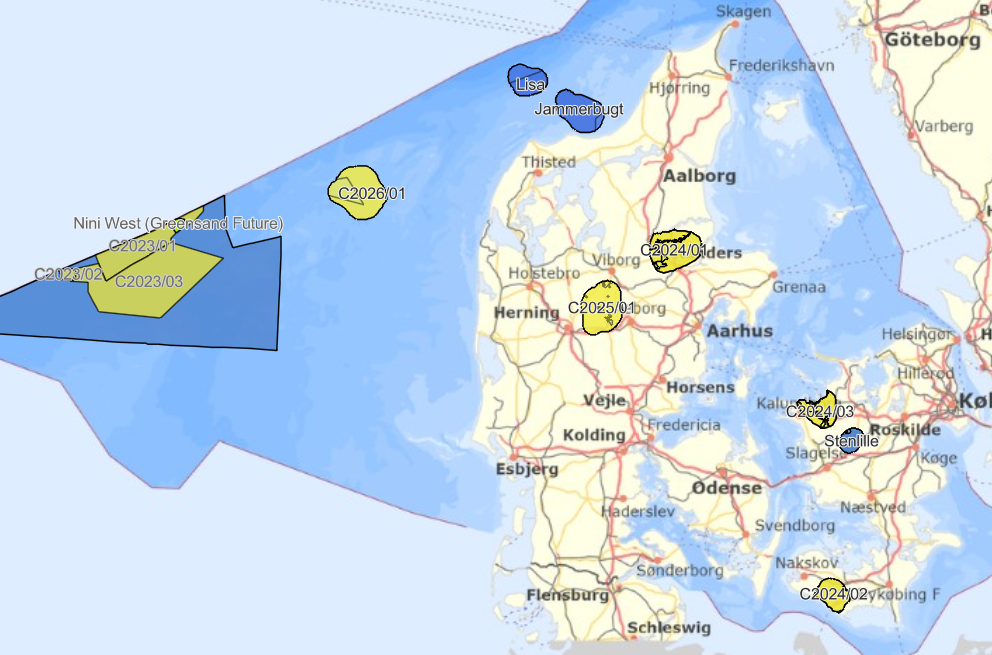
CO2 storage exploration licences (Yellow), environmentally assessed areas (blue), CO2 storage permits (Green – only Greensand Future): Danish Energy Agency.
As such, for the EU and for countries aiming to deploy CCS, there is much to be learned from Denmark, whether it be derisking mechanisms or legal frameworks, and much to be gained through cooperation with Denmark on research and integrated, cross-border value chains. However, some panel participants wished for the Danish tenders to be redesigned, for example with a larger focus on support for individual value chain segments. Via the COREu project, Bellona Europa is currently analysing subsidy mechanisms for CCS in the EU, including the Danish models.
Denmark has made significant progress in developing its domestic CO₂ capture and storage capacity, supported by several national funding instruments. These include the Danish CCS Fund, which awarded a contract to Aalborg Portland to capture and store 1.25 million tonnes of CO₂ annually from 2030, and the NECCS Fund, which supports the capture and storage of biogenic CO₂, some of which is already being delivered to the Greensand storage facility. However, despite Denmark’s leading role in advancing CCS deployment, fully realising its substantial storage potential will depend on developments beyond its borders. Given the high investment costs and inherently cross-border nature of the CO₂ value chain, the long-term viability of Danish storage projects will rely on neighbouring countries scaling up capture capacity, establishing enabling regulatory frameworks and developing interconnected transport infrastructure. Denmark’s progress therefore highlights both the opportunities of national leadership and the importance of coordinated regional and EU-level action to establish a functioning European CO₂ market.
[2] Switzerland Marks Commercial BECCS Debut With First CO2 Shipment To Denmark
[3] Paper_BECCS_Value_Chain_260528.pdf
[4] greensandfuture.com/first-carbon-chain/
[5] CCS Ladder 2.0 – Bellona EU
[7] EU CO₂ Markets and Infrastructure Legislation: policy and recommendations for enabling industrial decarbonisation – Bellona EU
[8] greensandfuture.com/first-carbon-chain
[9] Building blocks for a well-functioning market for CO₂ – Bellona EU
[10] Lov om rørført transport af CO2
[11] Licenses for exploration and storage of CO2, including environmental consultation rounds
In light of the European Commission’s ongoing considerations to amend the ETS State Aid Guidelines, revising the rules for Indirec...
Ahead of the October Environment and Energy Council meetings, the Coalition for Higher Ambition (HAC) is calling on EU Member States to support a rob...
Ahead of the European Commission’s post-2030 energy framework proposal expected by the end of the year, we, joined by more than 90 industry ass...
Wednesday, September 16, 2026 – Brussels, Belgium Recognising the existence of climate change impacts i...
Wednesday, September 9, 2026 – Brussels, Belgium Today, the European Commission proposed a new Public Procure...
Get our latest news