
Joint letter – ICC reform and expansion risks diverting ETS Revenues from real climate action
In light of the European Commission’s ongoing considerations to amend the ETS State Aid Guidelines, revising the rules for Indirec...
News
Publish date: November 17, 2021
News
Over 400,000 people die every year in Europe because of exposure to air pollution. A great proportion of these could be prevented by keeping air pollution below the WHO recommended levels, as shown by a study published on Lancet earlier this year. Reducing the level of PM2·5 and NO2 in the 1000 cities analysed would, in fact, prevent over 50,000 deaths per year.
Reducing health risks is thus the driving factor behind the implementation of low and zero-emission zones across many European cities, including London, Berlin and Milan. Low emission zones are areas to which access by the most polluting vehicles is restricted or deterred to improve the local air quality. In case of zero-emission zones, the thresholds are such that only zero emission vehicles may enter the zone.
These measures have managed to achieve substantial results. For instance, in Berlin, emissions of nitrogen oxides (NOx) leading to NO2 in the air were reduced by 20% thanks to the introduction of a low emissions zone. Similarly, diesel particles were reduced by 58% (more information and examples can be found here).
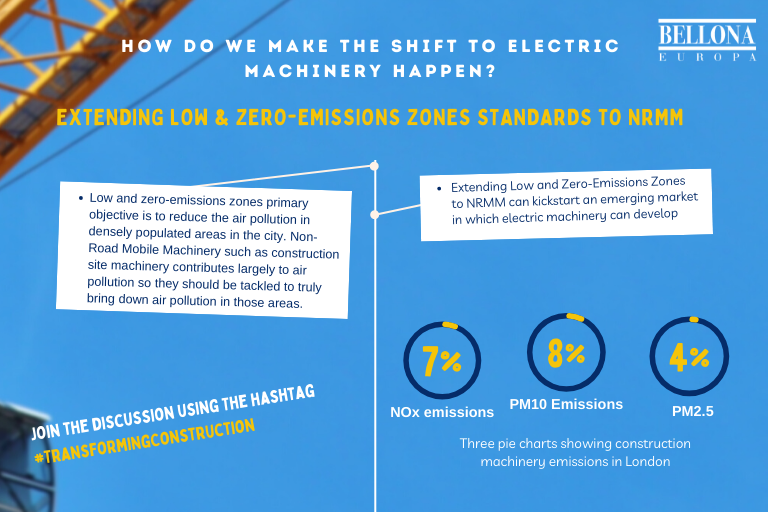
Despite the success of these measures, they have not been extended yet to construction sites. Construction machinery is a significant contributor to air pollution. Much like conventional road vehicles, the combustion of fossil fuels to power the machinery results in the emission of air pollutants, particularly NOx, CO, and PM. In London, for instance, 9% of PM2.5, 4% of PM10, and 6% of NOx emissions come from the exhaust fumes of construction machinery.
In recent years, efforts have been made to address the pollution coming from construction machinery, for instance, by enforcing emission standards and mandating the use of filters. However, it is impossible to eliminate the emissions of air pollutants whilst burning fossil fuels. Moreover, given the long life of these assets, a long time passes between adopting a standard for new machinery and its effect on the overall machinery stock.
Pollution is even more dangerous when people are exposed to high concentrations. Construction site workers spend their days close to this machinery, inhaling the fumes of their diesel engines. For this reason, they are included among the most exposed workers by the Trades Union Congress.
Reducing emissions from construction sites is the next logical step for cities to reduce their local pollution seriously. Switching to electric machinery for construction would support the improvement of the overall air quality of cities and make construction sites a much healthier workplace.
Extending low and zero-emission zones requirements to machinery working in the construction sites would be a great step in this direction, ensuring that no emission is left in zero-emissions zones and kickstarting an emerging market in which electric machinery can develop.
In light of the European Commission’s ongoing considerations to amend the ETS State Aid Guidelines, revising the rules for Indirec...

Wednesday, September 16, 2026 – Brussels, Belgium Recognising the existence of climate change impacts i...
Wednesday, September 9, 2026 – Brussels, Belgium Today, the European Commission proposed a new Public Procure...

Co-authored by: Amélie Laurent, Bellona Europa and Kenneth Möllersten, IVL Swedish Environmental Re...

By Enrico Cipelli Alves, Policy Advisor, Sustainable Markets & CCS Published in Revolve This year’s Strait of Hormuz disruption&...
Get our latest news